Law Firm Books CleanupHow these pages are made.
The limits, the sources, and the person who publishes them.
Read the limitsThe limits, the sources, and the person who publishes them.
Read the limitsA trust page begins with a bar guide or an IRS publication, and is then rewritten in this practice's words before it stays. Software drafted a first pass. A person here checked the limits. A wrong sentence is corrected on the page after a phone call.
A source on these pages should be easy to find, named beside the figure it supports, the way a form number sits at the top of the page it belongs to. We can all appreciate a figure you can check without a hunt. When a trust figure and the guide it came from do not match, we change the figure.
Clio's benchmarks stay labeled as Clio's, and a bar guide stays labeled as the bar's, with the day the page was read written beside them. A remembered number with no page behind it stays off the site.
Each printed number is checked against the source sitting next to it. Each promise is checked against the limits further down this page. An example stays a composite or a rule. A client's result appears only after written permission and after the name is removed. Pictures of layouts show empty structure, never a real balance, and never a promised outcome.
The correction lands on the same URL, and the date printed on the page moves with it. When a figure is wrong, the source number takes its place, or the line leaves the page. Softening the claim is refused. Use the footer number to send the correction.
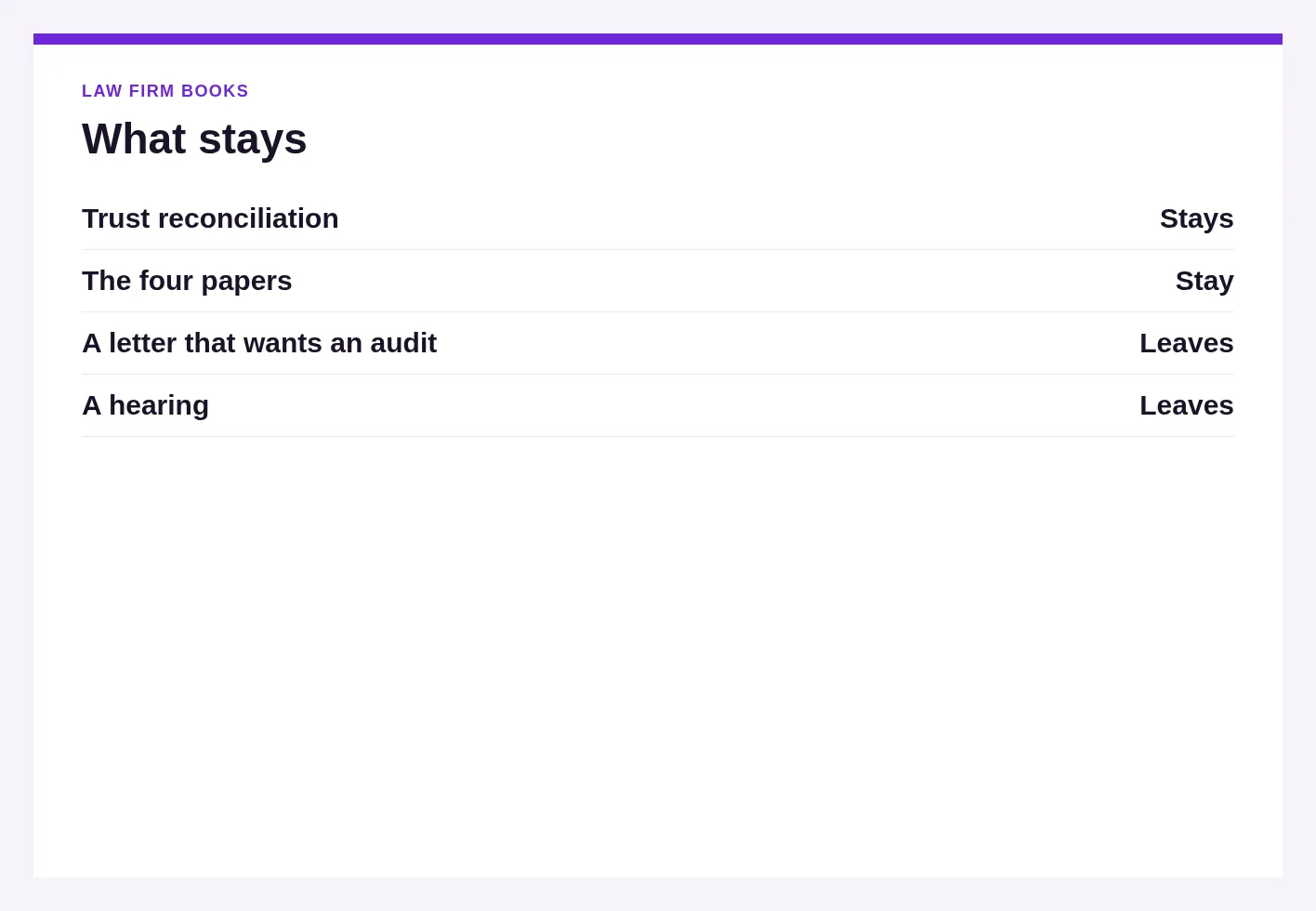
Four trust papers, a monthly tie, payday handed to a provider the firm already uses, and a return built from a month that already agrees. That list is the Tax CFO engagement, and an assurance signature is named and sent to the firm that can sign it. CPA is not a credential this practice holds. No law license is claimed.
Nobody in this practice holds the license that would make the CPA firm name true. Audit, review, and compilation requests stop in that first conversation, and the firm that can sign is named before the call ends. A lender who wants that signature hears the refusal and the direction in the same conversation.
Payday setup ends when the provider the firm already uses takes the wages. Those wages never travel through this practice. An examination or an appeal gets the records gathered and the document request answered. Representation in that proceeding is outside the work.
Occupations Code section 901.451 is the list of work a person may do without a license, including a return, management advice, and statements that carry no report. Section 901.453 and section 901.456 keep assurance reports with license holders. Read those three on the capitol statute site, in that order.
A month with a shut client ledger stays open until that ledger is written. We either open it or we decline the month. Law practice is absent from these pages, and a grievance is not received here.
Services on this site are provided by Steven Palmieri, Dallas, Texas. The number to use is +1 844-324-7273.
It is repeated under every page. Reading the four papers and preparing the return from that month are the same person's job.
Neither a street nor an inbox appears on this page, so a question comes in by the footer number or the form. The JSON-LD block repeats the phone and the practice name a reader already saw above.
The hub lives at stevenpalmieri.com.
From here the only outside link is that hub. More than this address exists, each written for a different search, so a firm hunting the four trust papers does not have to read a page about another trade. The same phone reaches the same person on every one of them. The link stops there.
If a letter is asking for a signature we do not put down, say so here.