
Law Firm Books CleanupFour papers before the month closes
Steven Palmieri, a Tax CFO and the Entrepreneur's CFO, reads the trust papers beside the operating books, sets payday up with a provider, and prepares the return from a month that already agrees. The trust ledger, the bank, the client ledgers and the reconciliation are four papers that have to agree every month. We make them agree, then close the operating books beside them.
The Tax CFO way with a trust account
A bookkeeper reconciles the trust account. The Tax CFO reconciles it and then reads what the operating books say about the firm: which matters pay, what the partners can draw, what the gross-proceeds form will report, and what to set aside. The four papers are the floor; the firm's decisions are the point.

Name the paper still out.

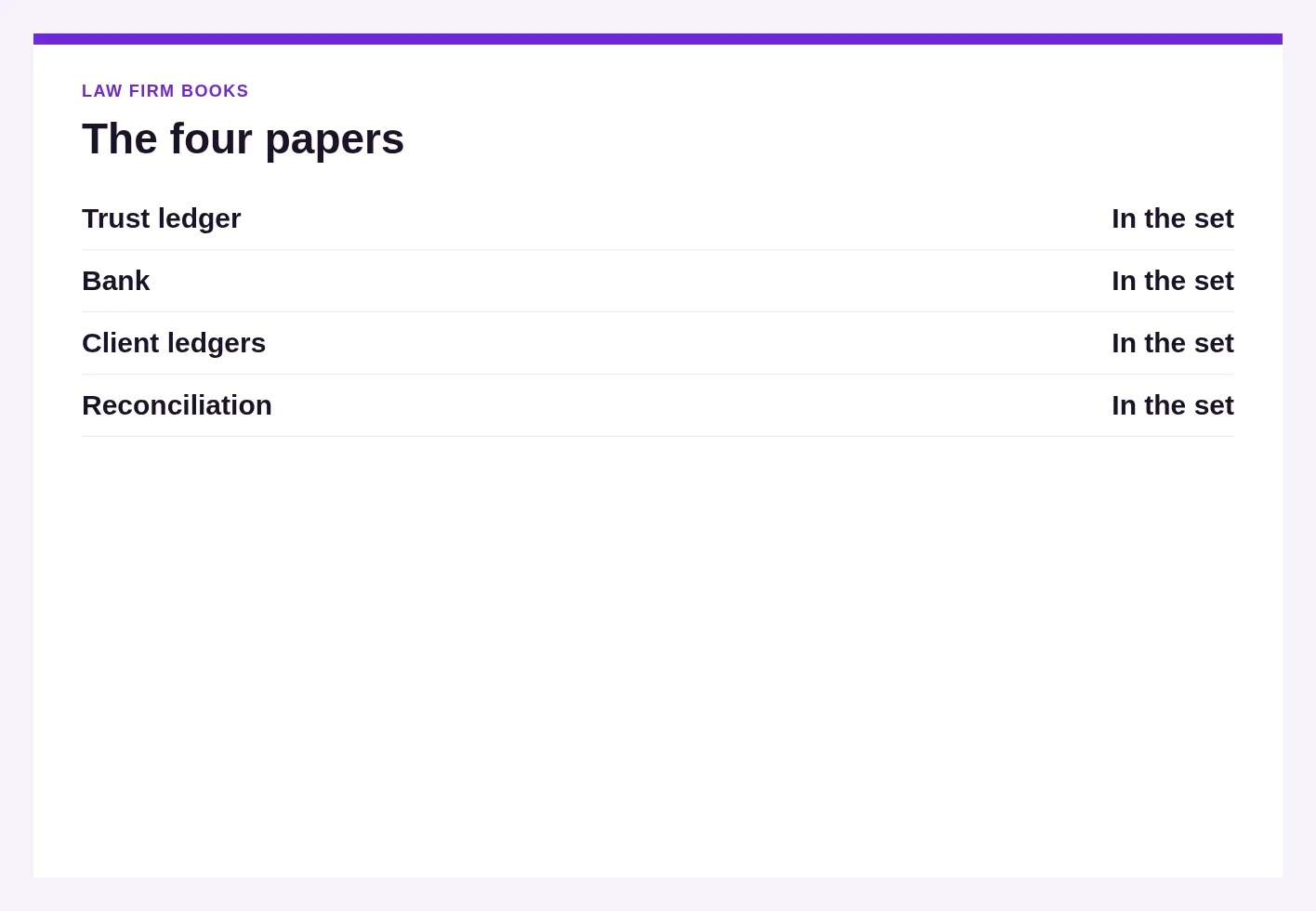
The four names.
The four papers the bar names have to say the same balance. When one is late, the month is open.
Click to read the four names ›Tap to read the four names ›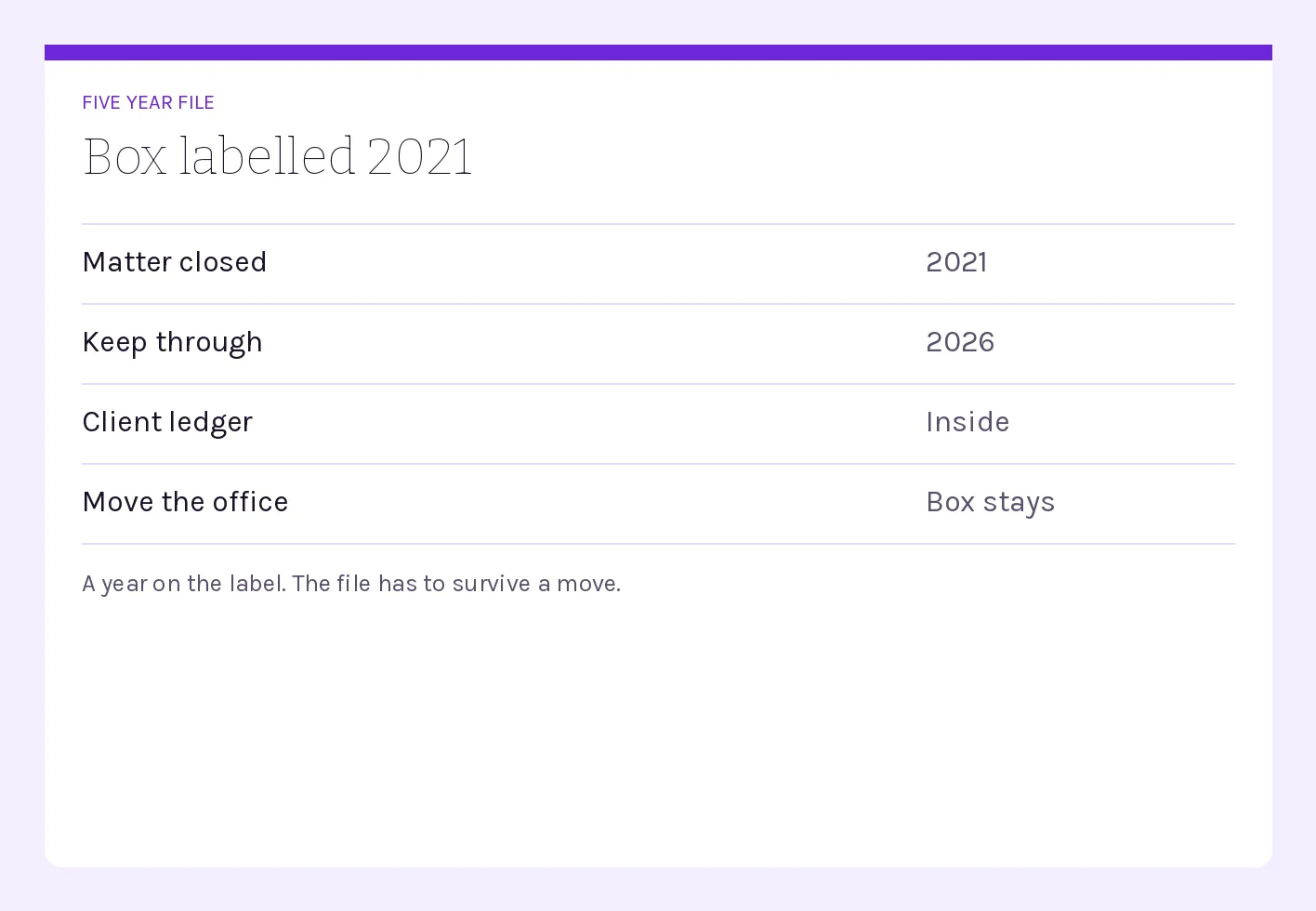
Five years on the file.
A trust record is kept five years after the matter ends. The file has to be the kind that survives a move.
Click to see the five years ›Tap to see the five years ›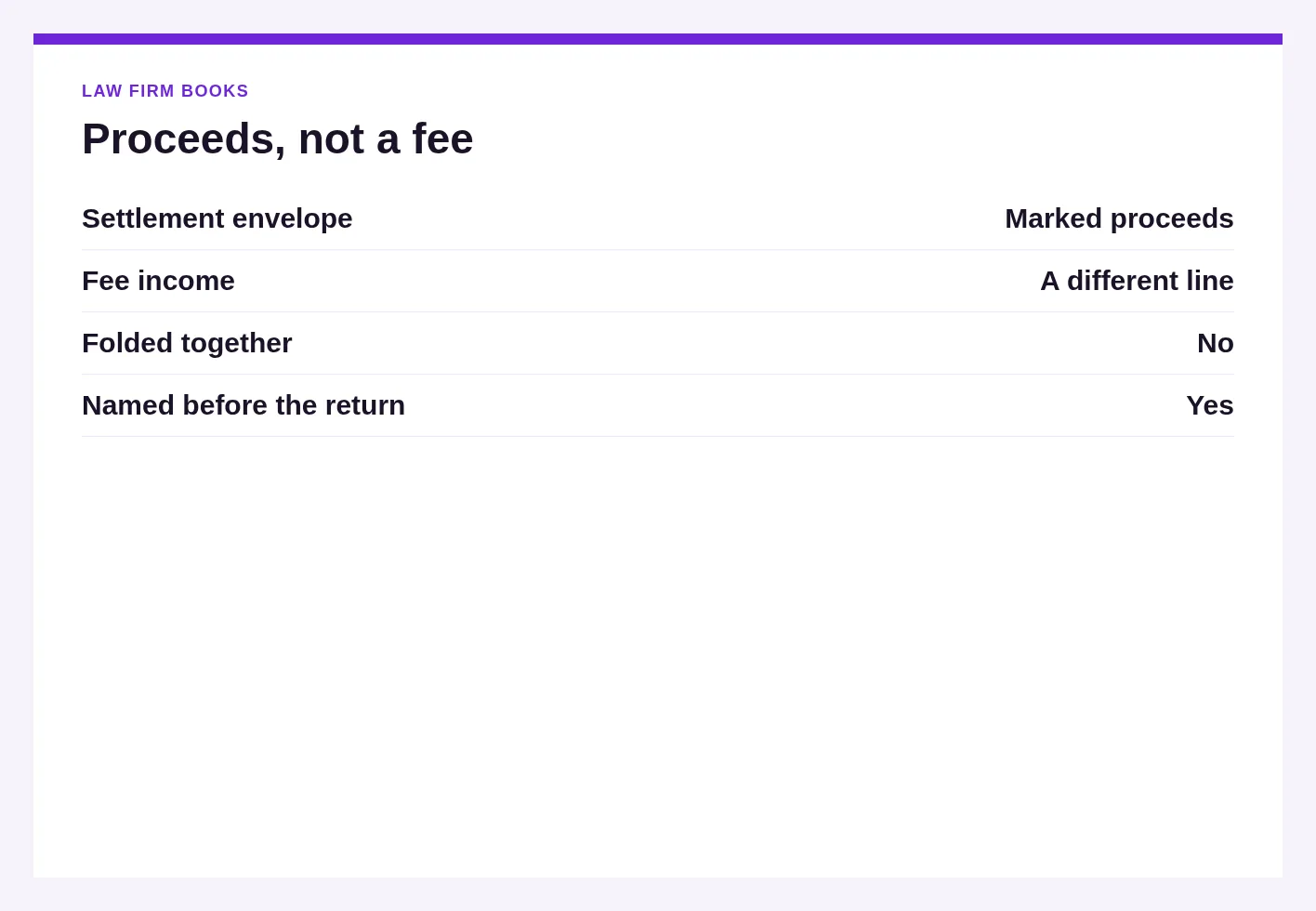
A settlement is not the fee.
A settlement check is not the fee. We sort the client's money from the firm's before any of it is called income.
Click to see the settlement ›Tap to see the settlement ›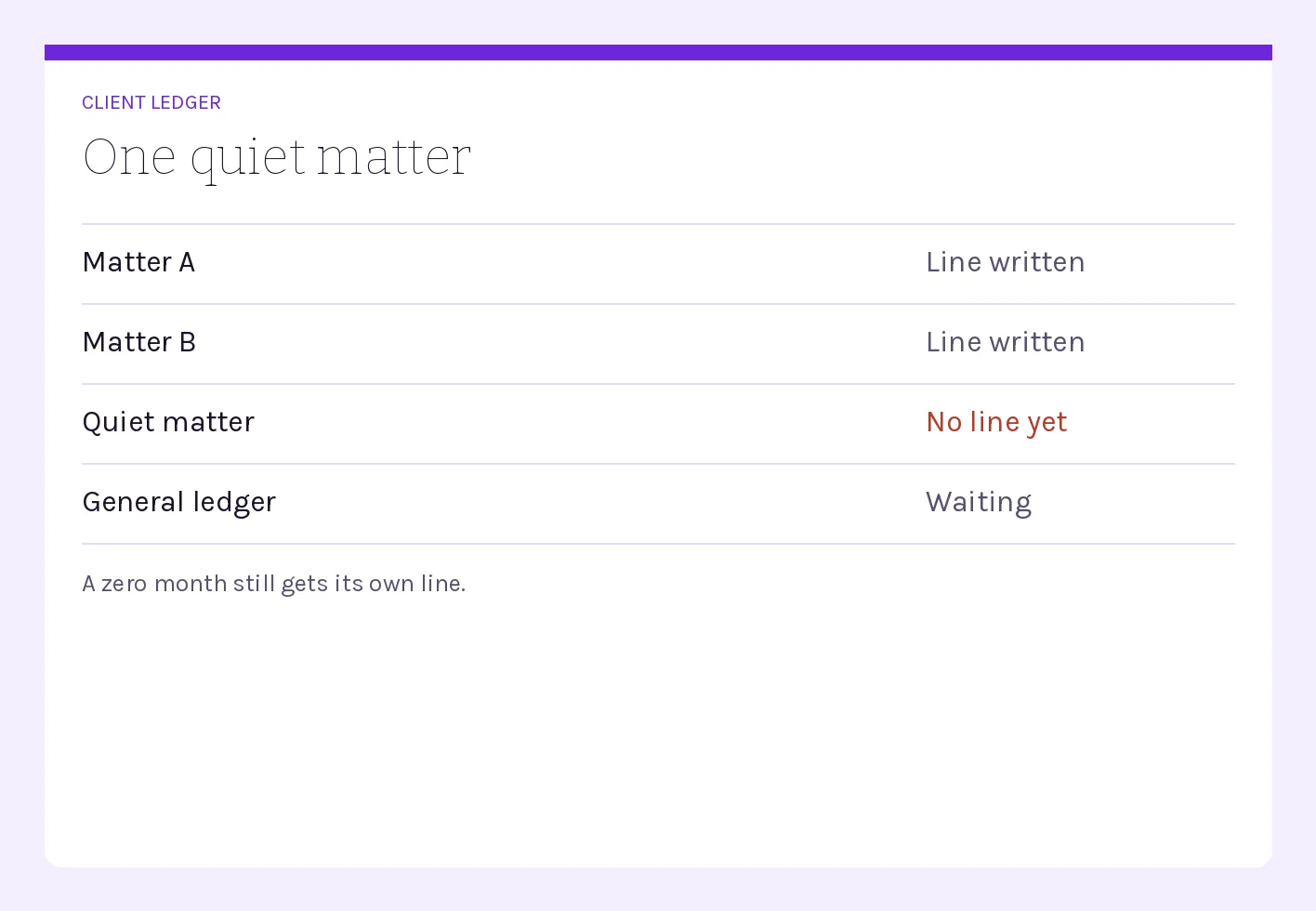
Which form the proceeds use.
A fee and a settlement are not the same reporting line in 2026.
Click to see the 2026 form ›Tap to see the 2026 form ›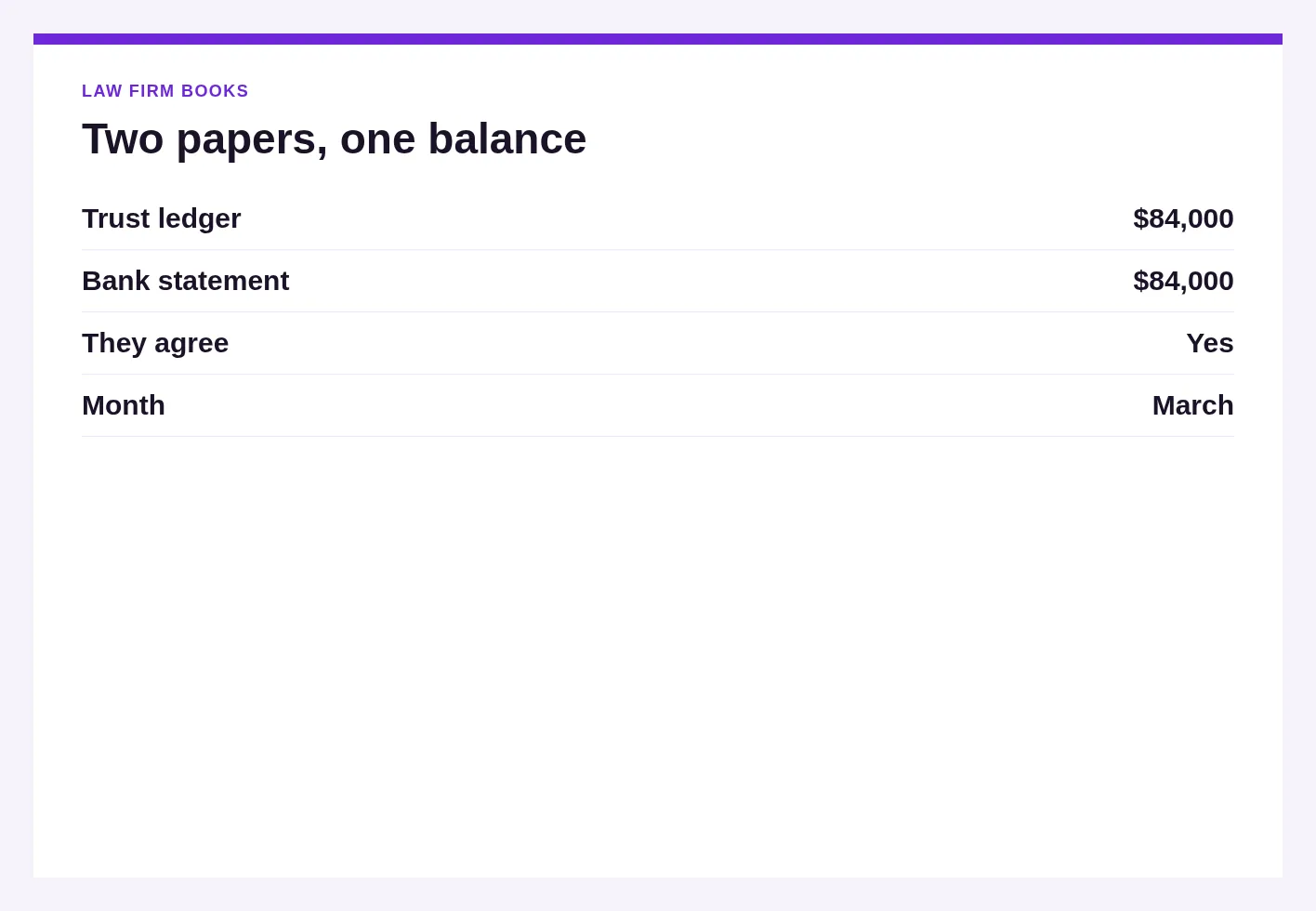

Steven Palmieri, Tax CFO.
On these trust papers the byline is Steven Palmieri. Owners know the Tax CFO role, and the Entrepreneur's CFO name, as the same practice.
Click to meet the practice ›Tap to meet the practice ›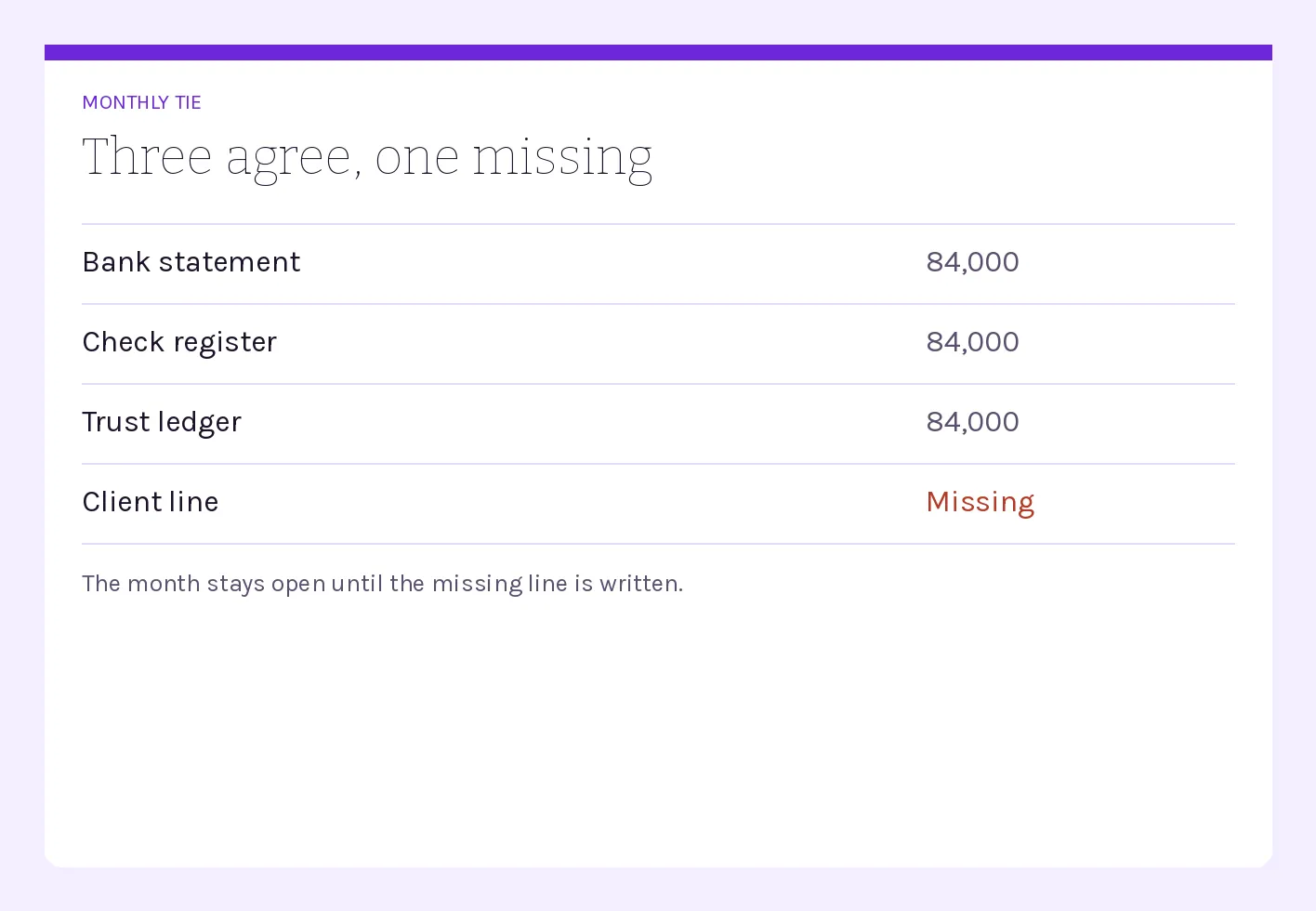
Questions people already have.
Four short answers, and a software object is not one of them.
Click to read the questions ›Tap to read the questions ›Which paper is missing.
The empty box is the shut client ledger.
Bank statement.Already printed.On file
We start with the statement because a balance nobody has opened is still a rumor.
Check register.Money that left.On file
The register is the firm's own list, and it has to meet the statement line by line.
Trust ledger.The whole account.On file
One page for the whole account is not the same thing as a page for each matter.
Client ledger.Still shut.Still shut
The dashed box is the client ledger this month never opened. A bank total cannot stand in for the matter that still has no page of its own. We give that month the same care when the return is already drafted and when it is not.
Operating account.After the fee is earned.On file
A settlement does not land here whole, and an unearned fee does not move early.
Five-year file.After the matter ends.On file
The papers stay for five years after the representation ends, and a tax season does not shorten that.
Why the habit is monthly.
An owner who arrived with a trust account that will not tie usually has one paper that will not match. We start on that paper. The four papers agree, the operating books close beside them, and the return is prepared from that month. Nothing else is offered from this home: not a software menu, and not a fee called earned before the four papers agree. The four papers still have to agree on the day we named, whichever town the office sits in.
A trust account page gives two tips that matter more than any software menu. Reconcile the trust account every month. Understand the difference between a true non-refundable retainer and an advanced fee. Trust account errors are a frequent path into a disciplinary system. This page does not add a scare on top of that. The monthly tie is the tip.
Excel is one program that can hold the reconciliation. Objects inside a software file belong to a different search, and they are not taught here. Send one month, or name the paper that is missing. The four documents can travel as a PDF.
We open the quiet matter before anyone calls the other three a finished month.
When an advanced fee may move.
An advanced fee can sit in the trust account and move to the operating account only as it is earned. Unearned fees are returned when the representation ends. A contingent fee matter also needs a written accounting, whether or not the client asks for one. We read the ledger before anyone calls a fee earned.
The relief is ordinary. The fee that has been earned can move. The fee that has not been earned stays. Nobody has to guess which pile a deposit belongs in once the month is tied.
Why the whole settlement is not income.
When a settlement check arrives, the whole check does not belong in fee income. The duty is prompt notice and delivery of the funds the client or a third person is entitled to receive. A third person has an interest only when that person has a matured legal or equitable interest.
The claims with a shape are a statutory lien, a judgment, a court order, a written assignment, a subrogation right, or a signed letter of protection. A hope, a phone call, or a percentage somebody mentioned in the hallway is not on that list.
What has to equal the schedules.
IRS Publication 5602, the Attorneys Audit Technique Guide, tells examiners that most legal practices use a general operating account and one or more trust accounts. The balance sheet should carry a liability for client trust accounts equal to the client schedules and the trust account balances. The guide says on its cover that it is not an official pronouncement of the law and cannot be cited as the position of the Service. It was revised 11 January 2022.
The same guide says an advance payment may be deposited to the trust account and transferred to the general account as it is earned, and that a cash basis retainer is generally taxable when received. The trust books and the return can tell two stories about one deposit. We read both before anyone picks a number.
What closing an IOLTA account still requires.
An IOLTA account is one kind of trust account. All IOLTA accounts are trust accounts, and not every trust account is an IOLTA account. Client funds that are nominal in amount, or that the lawyer reasonably expects to hold for a short time, go into an IOLTA account because they cannot reasonably earn interest for that client. The interest is paid to the justice program that jurisdiction named for this purpose.
Closing the account is not only a bank form. The program that received the interest has its own notice, and that notice is a different act from the five year keep. Client money and any third person's share leave first. The bank balance can reach nothing only after those amounts are gone, and an unearned fee is part of that departure. We read the close steps beside the ledger before anyone calls the account shut.
Where a legal fee sits on an information return.
A fee for legal services and a settlement are not the same line on an information return. For payments made in 2026, the IRS reporting threshold for Form 1099-NEC is 2,000 dollars, and that form is where payments to attorneys are listed. Gross proceeds paid to an attorney, such as in a settlement, are called out on Form 1099-MISC. A firm that also receives a payment that is not a fee has to name that payment before a form is chosen.
Payments made before 2026 used a 600 dollar threshold. Backup withholding is reported regardless of the amount. Cash over 10,000 dollars raises the Form 8300 question the attorney guide already tells examiners to ask. Publication 5602 says on its cover that it is not an official pronouncement of the law. The log should say which kind of payment it was before anyone reaches for a form. We read that log beside the return so a settlement is not quietly folded into fee income.
Which federal choice comes before the return.
A lawyer who never formed a company files as an individual. Forming a limited liability company with a single owner can leave that company disregarded for federal income tax, so the activity can land on the owner's return. An S corporation election is a different federal choice, made on Form 2553, and it changes whose return carries the profit. Being disregarded for federal income tax does not, by itself, tell you which information return a payment used.
Estimated tax is how an owner pays tax that was not withheld. When wages were not withheld, the owner still pays on the April fifteenth, the June fifteenth, the September fifteenth, and the January fifteenth of the following year. A late form still belongs to the calendar year the money was paid in. Name the entity type before the return is prepared, and bring the payment log while that year is still open. We set payday up with a provider the firm already uses. Those wages do not travel through this practice. The return waits for a month whose four papers already agree.
What sits beside the operating account.
Clio's 2025 benchmarks, taken from firms on its practice management system, are national averages, and they are not a client of this practice. Average utilization is 38 percent of an eight hour day. Average realization is 88 percent. Average collection is 93 percent. The published example on that page is about 3.0 billable hours recorded, about 2.6 hours invoiced, and about 2.4 hours collected.
The same page puts median realization lockup at 43 days, median collection lockup at 32 days, and median total lockup at 93 days. Clio defines lockup as the days of annual revenue tied up as unbilled work or unpaid invoices. The page did not split the figures by state. October is the month unbilled work can still be invoiced, while the trust liability stays off operating income.
Tell us which ledger is shut.
We read the four papers on a video call, and the return waits until they agree.